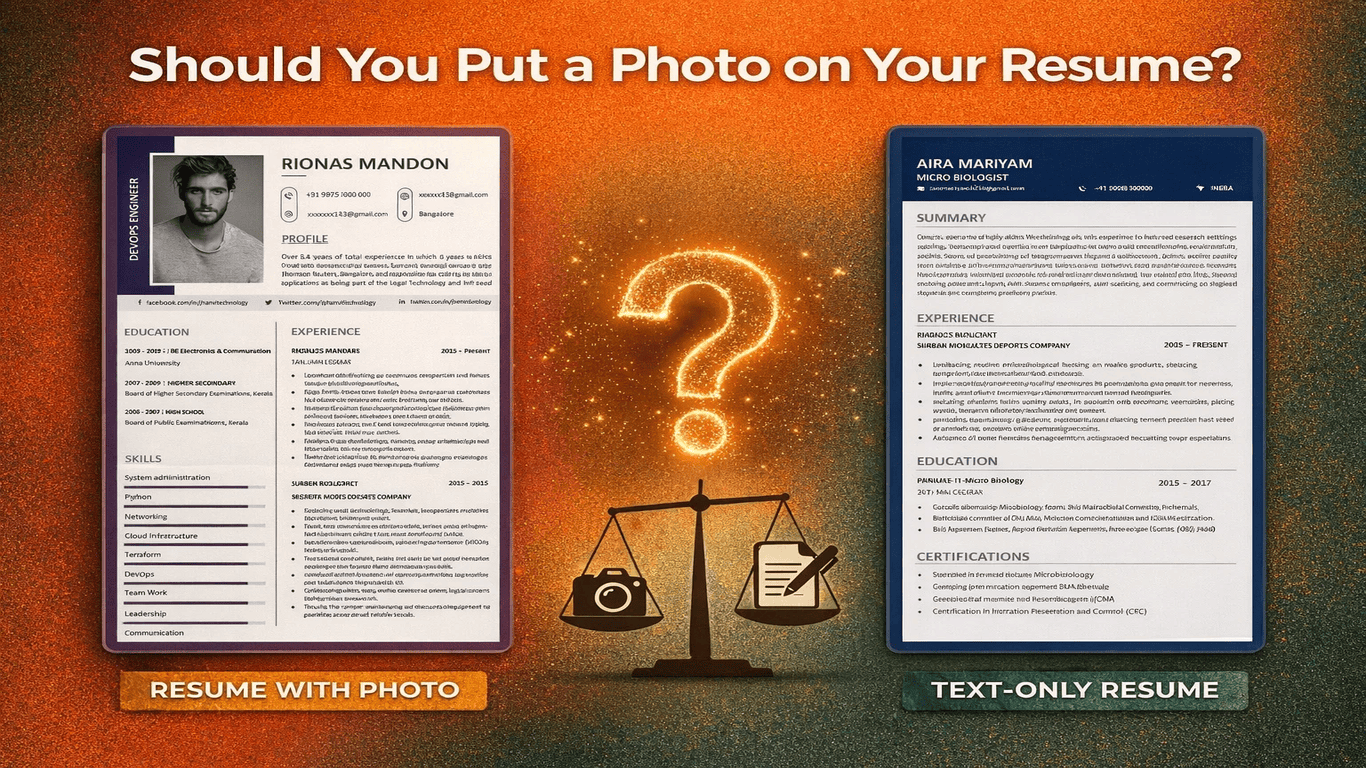
Two questions that Indian professionals ask more than almost anything else about their career documents: “Should I put my photo on my resume?” and “What is the difference between a CV and a resume?” The answers depend entirely on where you are applying, what industry you are targeting, and whether your application will pass through an Applicant Tracking System.
In this guide, we break down the photo question country by country, explain exactly how ATS handles images, and then clarify the CV vs resume distinction once and for all — with specific guidance for professionals in India, the Gulf (UAE, Saudi Arabia, Qatar), and those targeting international markets.
Part 1: Should You Put a Photo on Your Resume?
The short answer: it depends on where you are applying. Resume photo conventions vary dramatically between countries, industries, and even individual companies. Getting this wrong can cost you interview calls — or worse, get your resume rejected before a human ever sees it.
The ATS Problem with Resume Photos
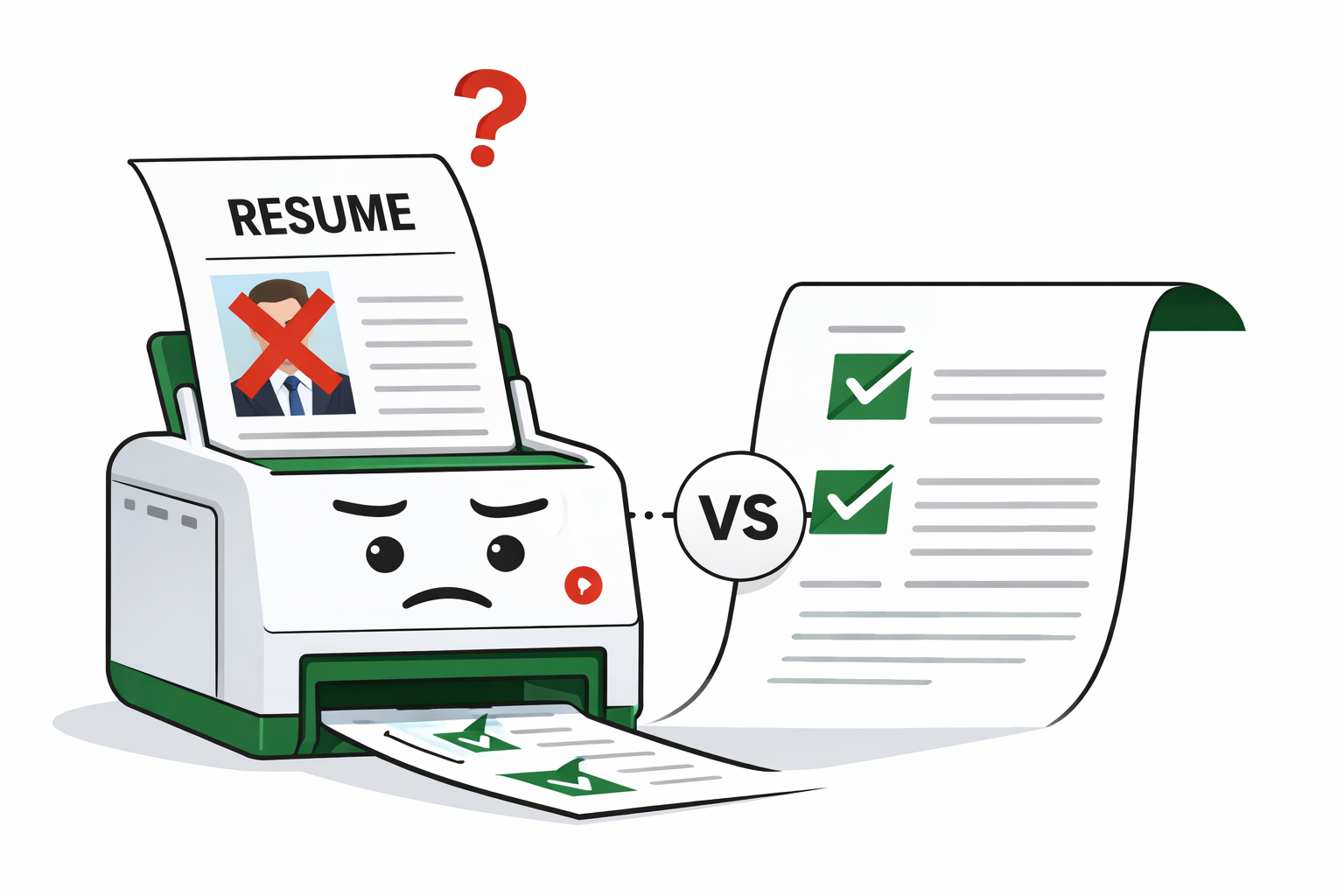
Before we look at country rules, you need to understand a critical technical fact: ATS software cannot process images. Every major Applicant Tracking System — Workday, Taleo, Greenhouse, Lever, iCIMS — evaluates only the text content of your resume. A photo takes up valuable space, adds zero keyword value, and can sometimes cause formatting errors during parsing.
For a deeper understanding of how ATS screening works, read our guide on how ATS software filters resumes before recruiter review.
Resume Photo Rules by Country
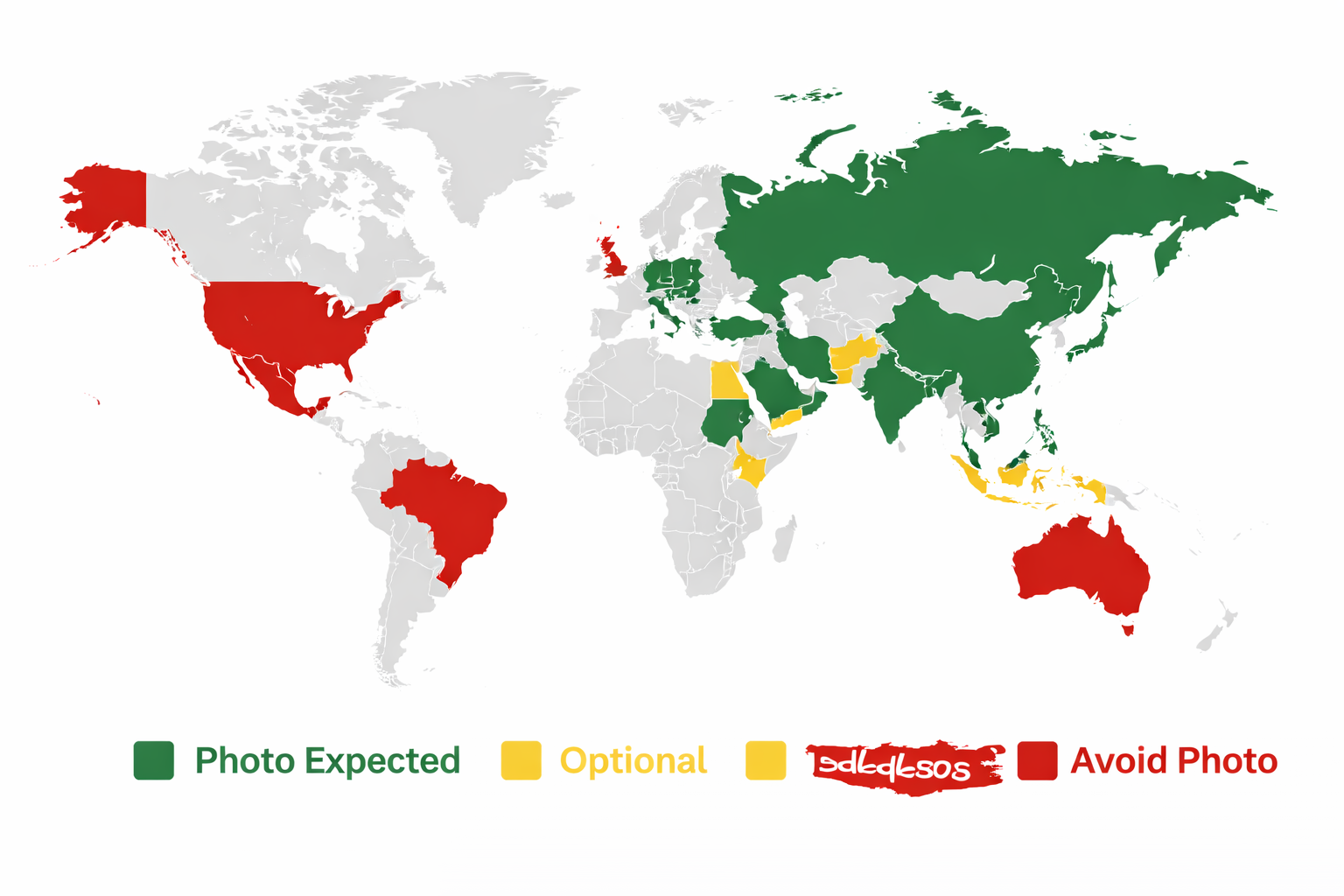
Here is a clear breakdown of photo expectations across every major job market that Indian professionals target:
| Country / Region | Photo? | Details |
|---|---|---|
| India | Optional | Not mandatory. Local companies may expect it; MNCs and ATS-driven hiring prefer no photo. Include only if the job posting specifically requests one. |
| UAE / Dubai | Common | Generally expected by local employers. International companies in free zones may follow Western norms. Professional headshot recommended. |
| Saudi Arabia | Common | Similar to UAE. Include a professional photo for local company applications. MNCs may not require it. |
| Qatar | Common | Expected for most local applications. Professional passport-style photo in the header. |
| USA | ❌ Avoid | EEOC regulations discourage photos to prevent discrimination. Including one may get your resume rejected. |
| UK | ❌ Avoid | Strong anti-discrimination norms. Photos are not expected and may be viewed negatively. |
| Canada | ❌ Avoid | Similar to US. Anti-discrimination employment laws apply. Skip the photo. |
| Australia | ❌ Avoid | Photos not expected. Focus on skills and achievements instead. |
| Germany / Austria | ✅ Expected | Traditional expectation. Professional headshot (Bewerbungsfoto) is standard. However, some modern companies are shifting away from this. |
| France / Spain / Italy | ✅ Common | Photo is generally expected on CVs. Professional quality is important. |
| Japan / China | ✅ Required | Passport-sized photo is mandatory on Japanese rirekisho. China also expects photos on both Chinese and English versions. |
When to Include a Photo (Even in India)
Even in markets where photos are optional, there are specific situations where including one makes sense:
- The job posting explicitly requests a photo — some government forms, cabin crew applications, and hospitality roles require it.
- Client-facing or media roles — acting, modelling, TV anchoring, luxury hospitality, and front-desk positions where appearance is part of the job requirement.
- Local Indian companies that follow traditional hiring practices — smaller firms and regional companies may expect a photo as part of a “complete” application.
- Gulf country applications — when applying directly to local UAE, Saudi, or Qatar employers (not through Western MNCs).
When to Skip the Photo (Our Recommendation)
For most Indian professionals applying to MNCs, IT companies, startups, or any role that uses ATS-based hiring, our recommendation is to skip the photo and instead:
- Include a link to your optimized LinkedIn profile where your professional headshot is visible — this gives recruiters a way to see your face without compromising ATS compatibility.
- Use the space for an additional skills keyword, a stronger professional summary, or a measurable achievement.
- Ensure your LinkedIn photo and resume messaging are consistent for brand alignment.
Need help creating an ATS-friendly resume without a photo? Our professional resume writing service delivers ATS-optimized resumes starting at ₹799, designed to pass automated screening and impress recruiters — with or without a photo, depending on your target market.
Part 2: What Is the Difference Between a CV and a Resume?
This is one of the most commonly confused topics in career document preparation — and the answer changes depending on which country you are in.
The US/Canada Definition (Different Documents)
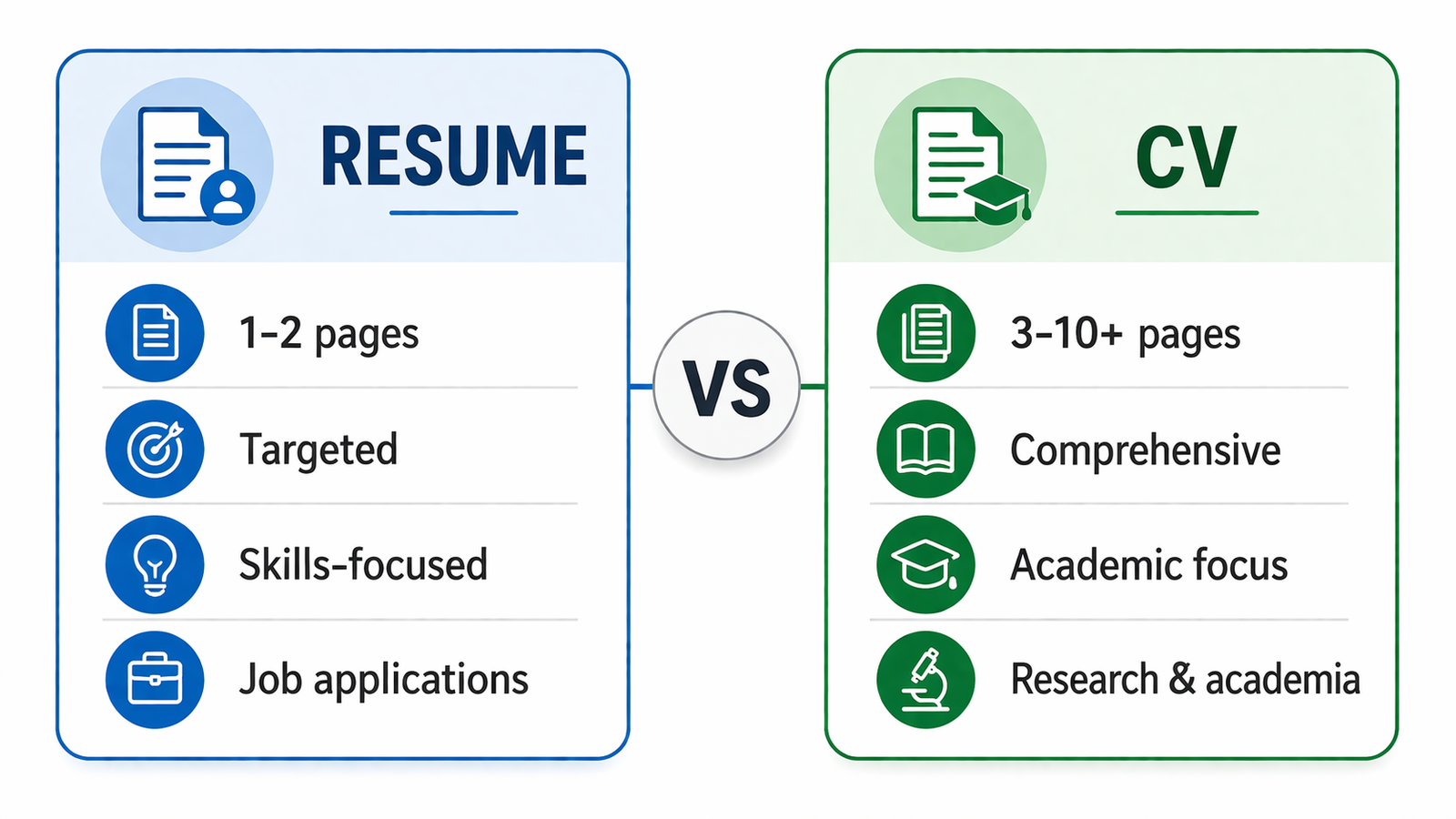
In the United States and Canada, a resume and a CV are two completely different documents:
📄 Resume (USA/Canada)
- Length: 1-2 pages maximum
- Purpose: Targeted job applications
- Content: Relevant skills, recent experience, key achievements
- Format: Concise, tailored per job
- Used for: Corporate, business, tech, most industries
- Analogy: A highlight reel
📋 CV (USA/Canada)
- Length: 3-10+ pages (no limit)
- Purpose: Academic, research, medical
- Content: Complete career history, publications, grants, conferences
- Format: Comprehensive, chronological
- Used for: Universities, research labs, medical positions
- Analogy: The complete filmography
The Rest of the World (Same Document, Different Name)
Outside the US and Canada — including India, UK, Europe, Gulf, Australia, and most of Asia — the terms “CV” and “resume” are used interchangeably. They both refer to the same 1-2 page job application document.
In India specifically, you will hear three terms used to describe the same thing:
- Resume — the most common term in IT, startup, and MNC hiring.
- CV (Curriculum Vitae) — commonly used in academic, government, and traditional corporate contexts.
- Biodata — an older term still used in some government applications and matrimonial contexts, though it is falling out of professional use.
Special Formats You Should Know
Depending on your target market, you may need a specific format beyond a standard resume or CV:
- Europass CV — the standardized CV format accepted across EU countries. Includes a CEFR language proficiency grid. Required for many European job applications and EU Blue Card submissions. Our Europass CV writing service creates these at ₹999.
- Gulf CV — for UAE, Saudi, and Qatar applications. Typically 2-3 pages, includes nationality, visa status, and sometimes a photo. Our Dubai and Qatar resume services specialize in these formats.
- Federal Resume (USA) — US government jobs require a detailed resume following specific formatting rules, often 4-6 pages.
How to Choose the Right Format for Your Career Goals
Use this decision framework:
- Applying to Indian IT/MNC/startup? → Standard 1-2 page resume, no photo, ATS-optimized. Starting at ₹799.
- Applying to Gulf countries? → 2-3 page CV with photo, nationality, visa status. Dubai / Qatar formats available.
- Applying to UK/USA/Canada/Australia? → 1-2 page resume, no photo, strong keywords. European format (₹999) available.
- Applying to European companies? → Europass CV with CEFR language grid. Photo expected in Germany/France.
- Academic/research position? → Full academic CV with publications, grants, and conferences. Custom format (₹1,499).
No matter which format you need, your resume should be complemented by a strong cover letter and an optimized LinkedIn profile — together these three documents create a unified professional brand that maximizes your interview chances.
For a deeper understanding of LinkedIn’s role alongside your resume, read our guide on LinkedIn profile optimization in 2026.
Not Sure Which Resume Format You Need?
WhatsApp us for a free consultation. We will assess your target market, career level, and goals — then recommend the perfect format. ATS-optimized resumes from ₹799. Delivered within 24 hours.
WhatsApp Now- Free ConsultationView All Pricing · Contact Us · Kerala Service · Bangalore Service