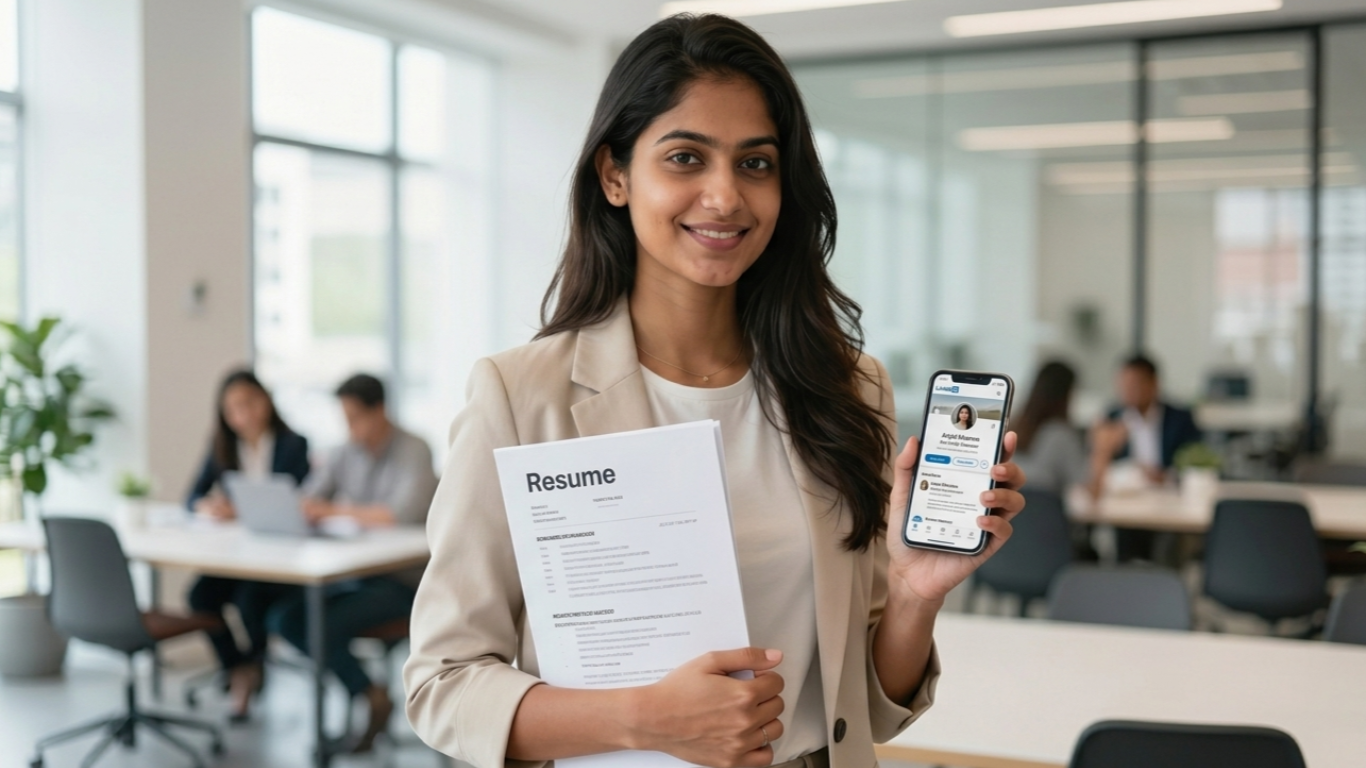
In 2026, the question is no longer “Should I have a resume?” or “Should I be on LinkedIn?” — it is “Am I using both strategically?” The modern job market has bifurcated into two distinct arenas: the discovery arena, where LinkedIn’s AI-powered algorithm surfaces your profile to recruiters before you even apply, and the conversion arena, where your resume either wins or loses you an interview slot. Mastering only one of these is no longer enough.
Here is a definitive breakdown of how resumes and LinkedIn profiles differ, when each one matters, and how to ensure both are working together as a unified career strategy in 2026.
1. The Core Difference: Discovery vs. Conversion
The most important concept to understand in 2026 is that your LinkedIn profile and your resume perform two completely different jobs in the hiring funnel — and confusing them is the single biggest mistake job seekers make.
Your LinkedIn profile is a discovery engine. It runs 24 hours a day, indexed by LinkedIn’s LLM-powered search algorithm, surfacing you to recruiters who are actively searching for someone with your skills — even when you are not actively job hunting. It is your always-on personal brand.
Your resume is a conversion tool. It is a tightly tailored, role-specific document that persuades a specific hiring manager, at a specific company, to invite you for a specific interview. It exists to answer one question: “Why should we choose this person over 200 other applicants?”

2. What Your Resume Does That LinkedIn Cannot
Despite the rise of LinkedIn, the resume remains irreplaceable in 2026 for five critical reasons. If you’re unsure how to build an ATS-ready resume, explore our Resume Writing Services or read our detailed AI-Friendly Resume guide.
- ATS Compatibility: 98% of Fortune 500 companies and most mid-sized firms route all applications through an Applicant Tracking System (ATS). LinkedIn profiles are not parsed by ATS; only your submitted resume is. If your resume is not ATS-optimized, it is eliminated before a human ever reads it.
- Role-Specific Tailoring: A resume can — and must — be customized for each application. You can mirror the exact language of a job description, reorder bullet points to foreground the most relevant experience, and adjust your summary to address that company’s specific pain points. LinkedIn is a one-size-fits-all public document.
- Confidentiality: Many employed professionals cannot publicly broadcast that they are exploring new roles. A resume can be shared privately and selectively; LinkedIn updates are visible to your current employer.
- Formatting Control: A well-designed resume communicates professionalism and personal brand in a way your LinkedIn profile cannot. Visual hierarchy, white space, and typography choices on a resume all send non-verbal signals to hiring managers.
- The Legal Paper Trail: Resumes are formal application documents that become part of your candidate file. They carry a level of accountability that a LinkedIn profile — which you can edit at any time — does not.
3. What LinkedIn Does That Your Resume Cannot
LinkedIn’s capabilities in 2026 go far beyond anything a static document can achieve. Here is what your LinkedIn profile delivers that no resume ever could:
- Passive Inbound Opportunities: Recruiters search LinkedIn daily for candidates who are not actively applying. A well-optimized profile can generate recruiter InMails, freelance inquiries, speaking invitations, and partnership offers — entirely without you submitting a single application.
- Social Proof at Scale: Recommendations from managers and peers, skill endorsements from colleagues, and follower counts are forms of third-party validation that no resume can replicate. In 2026, these signals carry real algorithmic weight in LinkedIn Recruiter search rankings.
- Content Authority: Publishing posts, articles, and carousels on LinkedIn establishes you as a thought leader in your field. A Project Manager who writes insightful weekly posts about Agile methodology will rank higher in recruiter searches than an equally qualified candidate who is silent on the platform.
- Network Visibility: LinkedIn shows recruiters your mutual connections, which dramatically increases response rates on InMails. A warm introduction through a shared connection converts into an interview at 3x the rate of a cold application.
- Rich Media Portfolio: Videos, PDF carousels, project images, and external links in your Featured section demonstrate your work in ways a resume simply cannot contain.
To fully leverage LinkedIn’s discovery power, consider a professional LinkedIn Profile Makeover or dive deeper into strategies in our LinkedIn Optimization 2026 guide.
4. How AI-Powered Recruiters Use Both in 2026
Understanding the recruiter’s workflow in 2026 changes how you think about both documents. Here is the typical sequence:
- LinkedIn Search (Discovery): The recruiter opens LinkedIn Recruiter and enters a Boolean search — role title, skills, location, and seniority. Your profile either appears in the results or it does not. This is entirely determined by your profile optimization.
- Profile Scan (10 seconds): The recruiter glances at your headline, current company, and profile photo. If these match their criteria, they click through to your full profile. Your dwell-time-boosting Featured section now does its work.
- InMail or Application Request: If your profile compels them, they send an InMail or invite you to apply directly. At this point, LinkedIn has done its job.
- Resume Submission and ATS Parsing: You apply with your resume. The ATS parses it for keyword relevance, experience level, and educational requirements. A score is assigned. Below a threshold, you are filtered out automatically.
- Hiring Manager Review: If your ATS score qualifies, a human reads your resume. The hiring manager cross-references your LinkedIn profile to verify claims and check for additional context — especially recommendations and content history.
The critical takeaway: LinkedIn gets you seen; your resume gets you interviewed. A gap in either stage breaks the entire pipeline.
5. The Consistency Rule: What Must Match Between Both
While your resume and LinkedIn profile serve different purposes, certain elements must be consistent across both. Discrepancies between the two are a major red flag for hiring managers and HR teams in 2026 — and some companies now use AI tools specifically to cross-reference the two documents for inconsistencies.
The elements that must match exactly:
- Job titles and company names: Even minor variations (e.g., “Sr. Manager” on resume vs. “Senior Manager” on LinkedIn) can trigger ATS mismatch flags or recruiter skepticism.
- Employment dates: Gaps or overlaps that appear differently on each document will be questioned in interviews — and increasingly flagged by AI screening tools.
- Educational qualifications: Degree names, institutions, and graduation years must be identical on both platforms.
- Core achievements: The quantifiable results you claim (revenue figures, team sizes, growth percentages) must be consistent. Inflating numbers on one document and not the other is immediately suspicious.
6. Where They Should Intentionally Differ
Consistency in facts does not mean copying and pasting. There are specific areas where your LinkedIn profile and resume should deliberately diverge — and getting this balance right is what separates a good career strategy from a great one.
- Tone and voice: Your resume should be formal, third-person-adjacent, and concise. Your LinkedIn About section should be written in first person, conversational, and warmer — it is a human talking to other humans, not a document submitted to a committee.
- Length and depth: A resume must fit within 1–2 pages. Your LinkedIn profile has no such constraint. Use the extra space to tell fuller stories, include projects that didn’t make the resume cut, and add context that a hiring manager can explore at their own pace.
- Audience targeting: Your resume is addressed to one specific hiring manager at one specific company. Your LinkedIn profile is addressed to every recruiter in your industry simultaneously. Write accordingly.
- Skills presentation: On a resume, skills are curated to match a specific job description. On LinkedIn, you can — and should — list up to 100 skills to maximize your searchability across a wider range of recruiter queries.
- Recommendations and endorsements: These exist only on LinkedIn. Use them aggressively. A recommendation from a former director carries more weight on LinkedIn than any bullet point on a resume.
7. The 2026 Action Plan: Optimizing Both Simultaneously
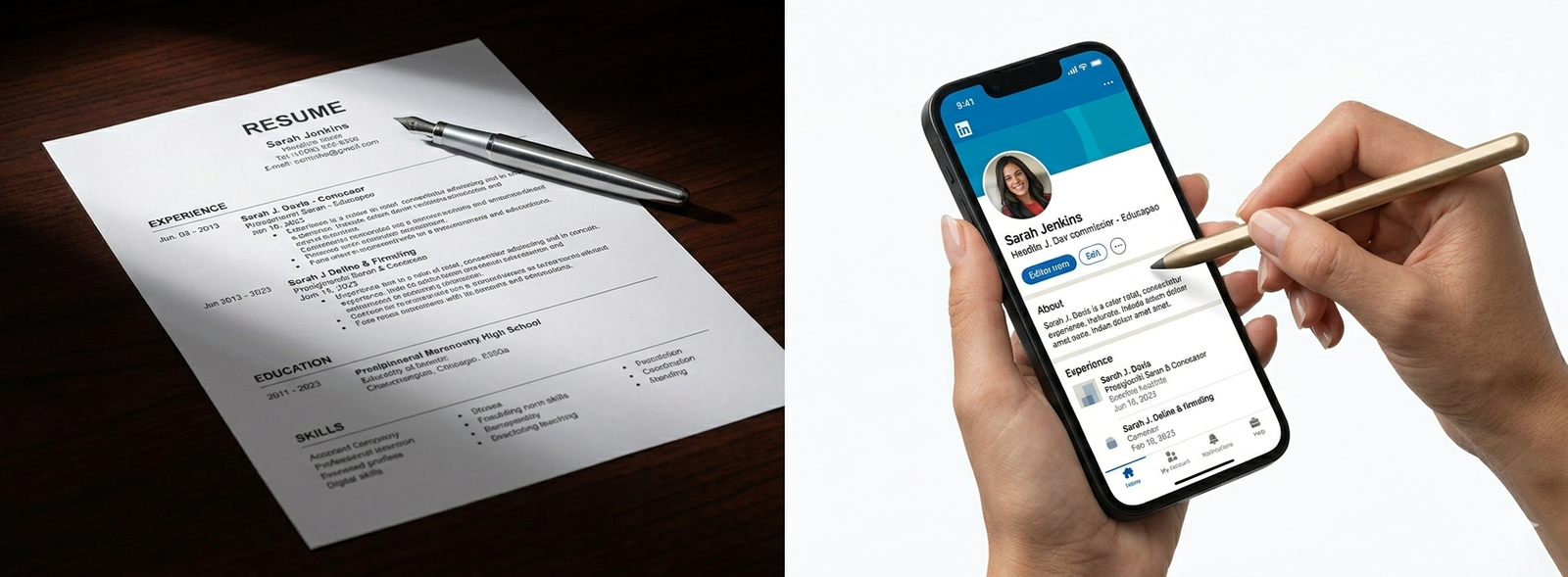
Rather than treating your resume and LinkedIn profile as separate projects, treat them as two outputs of a single Personal Brand Strategy. Here is a four-step framework to align them in 2026:
- Define your 2–3 core professional pillars. These are the themes — skills, industries, and outcomes — that define your professional identity. Every bullet point on your resume and every post on LinkedIn should reinforce these pillars. This is your Topic DNA.
- Build your Master Achievement Bank. Write 15–20 P.A.R.-based achievement statements (Problem → Action → Result) covering your entire career. Pull the most relevant 6–10 onto your resume for each application. Use all 15–20 on LinkedIn across your experience section and About section.
- Keyword map your target roles. Collect 5–7 job descriptions for roles you are targeting. Identify the 20 most frequently repeated keywords. Ensure these appear naturally in your resume (in the summary, skills, and experience sections) and in your LinkedIn headline, About section, and skills list.
- Set a quarterly review cadence. Every 3 months, update both documents simultaneously — new skills, new achievements, new certifications. What goes into your resume gets reflected on your LinkedIn profile and vice versa.
Conclusion: You Need Both — and You Need Them to Work Together
In 2026, the question is not “resume or LinkedIn?” — it is “how well are my resume and LinkedIn profile working together?” Professionals who treat them as a unified career strategy consistently outperform those who rely on one or the other. LinkedIn surfaces you to the opportunity; your resume closes it. Neither document alone completes the circuit.
The job market in 2026 rewards professionals who think like personal brand strategists — who understand that every line of their resume and every post on LinkedIn is a data point in an AI-driven hiring ecosystem that is evaluating them continuously, not just when they apply.
Want Both Your Resume and LinkedIn Profile Working at Full Power?
At Jhanvi Technologies, we offer expert Resume Writing and LinkedIn Profile Optimization services — crafted to work together as a single, high-impact career strategy. Our specialists deliver ATS-optimized, recruiter-ready documents in just 4 days. Starting at ₹2,499.
Get Your Career Documents Optimized →